
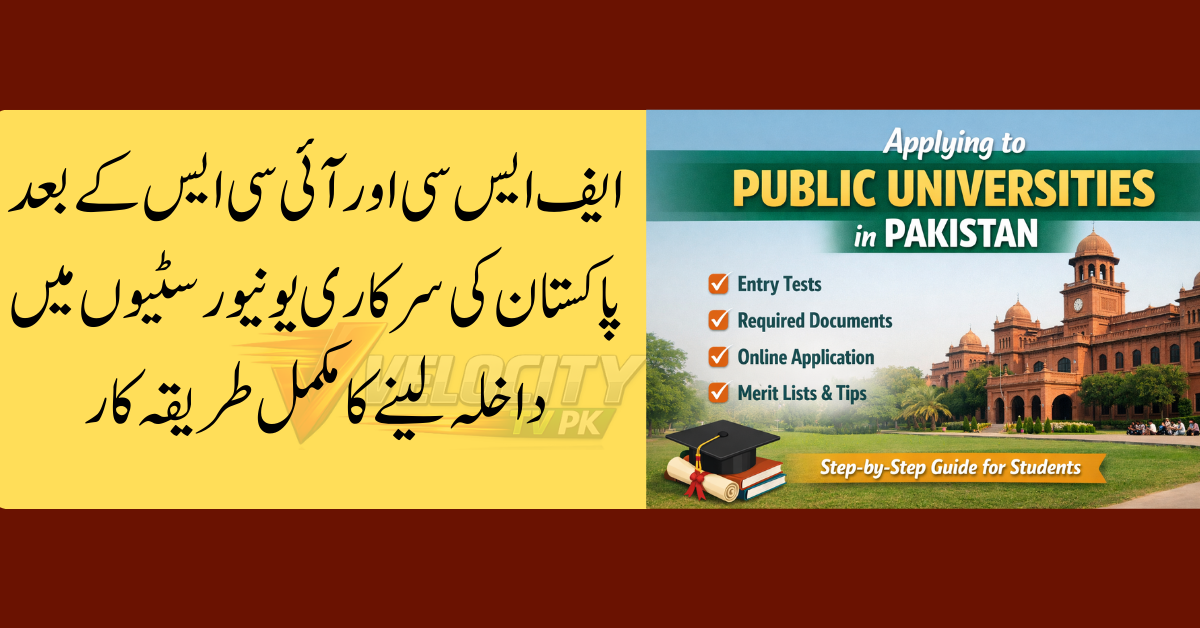
Choosing a university is one of the biggest decisions after FSc or ICS. For many students in Pakistan, public universities are the first choice because they offer quality education at affordable fees. But the admission process can feel confusing—entry tests, merit lists, online forms, deadlines—it’s easy to feel overwhelmed.
Don’t worry.
This complete beginner-friendly guide will walk you through every step of applying to public universities in Pakistan. Whether you’ve just completed FSc (Pre-Medical / Pre-Engineering) or ICS, this article will help you understand the timeline, requirements, documents, and common mistakes to avoid.
Let’s get started.
How to Apply for Public Universities in 2026?
1. Understanding the Admission Timeline in Pakistan
Before applying anywhere, you need to understand when admissions usually open.
In Pakistan, most public universities follow two main admission cycles:
Fall Admissions (Main Intake)
- Admissions Open: June – August
- Entry Tests: July – September
- Classes Start: September – October
This is the primary and most competitive intake. Almost all major programs are offered in Fall.
Spring Admissions (Limited Intake)
- Admissions Open: November – January
- Entry Tests (if required): December – January
- Classes Start: February – March
Not all programs are available in Spring, and fewer seats are offered.
Examples of Major Public Universities
If you are still exploring options, you can also check our detailed List of Universities in Pakistan – Province & City Wise Complete Guide (2026) to compare universities before applying.
University of the Punjab (PU) – Lahore
- Fall admissions usually open in June/July.
- Conducts its own entry test for many programs.
University of Karachi (UOK)
- Admissions generally begin in July.
- Offers a wide range of undergraduate programs.
University of Engineering and Technology (UET) Lahore
- Engineering admissions usually depend on ECAT.
- Highly competitive merit.
Each university publishes its own schedule on its official website. Always check the official announcement instead of relying only on social media posts.
2. Entry Test Requirements (Very Important)
Most public universities in Pakistan require an entry test for undergraduate admissions.
Here are the common ones:
For Engineering Programs
- ECAT (for engineering universities like UET)
- Sometimes university-specific tests
Students applying for MBBS should read our complete MBBS Admissions in Pakistan – Complete Guide for Students (2026) to understand the full admission structure.
For Medical Programs
- MDCAT (mandatory for MBBS/BDS in public and private colleges)
For General Programs (BS, BBA, BSCS, etc.)
- University’s own entry test
OR - Accept SAT (in some cases)
Some universities calculate merit based on:
- Matric marks
- FSc / ICS Part-I marks
- Entry test score
Make sure you:
- Register for the entry test before the deadline
- Download your roll number slip
- Reach the test center on time
Missing the entry test means missing admission completely.
3. Required Documents for Admission
When applying to a public university, you will usually need:
Academic Documents
- Matric certificate and mark sheet
- FSc / ICS Part-I result card
- FSc / ICS Part-II result (if announced)
- Equivalence certificate (for foreign boards)
Personal Documents
- CNIC or B-Form
- Father/Guardian CNIC copy
- Domicile certificate
- Recent passport-size photographs
Other Documents (If Required)
- Hafiz-e-Quran certificate
- Disability certificate
- Sports certificate
- Character certificate from college
Tip: Scan all documents clearly in PDF or JPG format before starting your online application.
You can also check the updated List of Medical Colleges in Pakistan 2026 – By Province and City to explore government and private options.
4. Step-by-Step Online Application Process
Most public universities in Pakistan now use online admission portals.
Here’s how the process usually works:
Step 1: Visit the Official Website
Go to the university’s official website and open the Admissions section.
Create an account using:
- Your email address
- Mobile number
- CNIC/B-Form
Make sure the email is active because important updates are sent there.
Step 2: Fill the Online Form
You will need to enter:
- Personal information
- Academic record
- Program preferences (choose carefully)
- Entry test details
Double-check spellings of your name and CNIC number.
Step 3: Upload Required Documents
Upload scanned copies of:
- Mark sheets
- CNIC
- Photograph
Ensure:
- Files are clear
- File size meets requirements
- Documents are not blurred
Step 4: Pay Application Fee
Most public universities charge an application fee between:
- Rs. 1,000 – Rs. 3,000 (approx.)
Payment methods may include:
- Bank challan
- Online banking
- EasyPaisa / JazzCash (in some cases)
Keep the payment receipt safe.
Step 5: Submit and Print Application
After submission:
- Download your application form
- Print a copy for your record
Some universities require you to send hard copies, but many now process everything online.
5. Understanding the Merit List Process
After the application deadline and entry test, universities prepare merit lists.
Here’s how it works:
Merit Calculation Formula (Example)
- Matric: 10–15%
- FSc/ICS: 40–50%
- Entry Test: 40–50%
This formula varies by university and program.
Types of Merit Lists
- First Merit List
- Second Merit List
- Third (and sometimes Fourth) Merit List
If your name appears:
- Download your offer letter
- Submit fee before the deadline
If you miss the fee deadline, your seat may be given to someone else.
Waiting List
If your name is not in the first list, don’t panic. Many students get selected in the second or third list.
Keep checking the website regularly.
Many students with excellent academic records still struggle in entry tests. Read our guide on Why Students With High Marks Still Fail Entry Tests to avoid common preparation mistakes.
6. Common Mistakes Students Make
Many students lose their chance because of small mistakes. Avoid these:
1. Missing Deadlines
Always mark important dates in your calendar.
2. Not Preparing for Entry Test
Some students think FSc marks are enough. Entry tests can make a huge difference in merit.
3. Choosing Wrong Program Preferences
Always list programs in order of interest. Don’t randomly select.
4. Uploading Blurred Documents
Unclear documents may lead to rejection.
5. Ignoring Merit Lists
Some students don’t check the website regularly and miss their name in the list.
7. Final Admission Checklist
Before you relax, go through this checklist:
Completed FSc / ICS
Applied for entry test
Prepared for entry test
Checked admission advertisement
Created online account
Filled form carefully
Uploaded clear documents
Paid application fee
Downloaded application copy
Checked merit lists regularly
Submitted fee before deadline
If all boxes are checked, you are on the right track.
8. Helpful Tips for Students After FSc / ICS
- Apply to multiple universities to increase chances.
- Keep copies of all documents in both soft and hard form.
- Stay updated through official websites only.
- Talk to seniors or teachers for guidance.
- Choose a program based on interest, not only on “trend.”
University life is a big step, but careful planning makes the process smooth.
Frequently Asked Questions (FAQs)
1. Can I apply before my FSc Part-II result is announced?
Yes, most universities allow you to apply based on Part-I results. Final admission remains conditional until Part-II result is submitted.
2. Is entry test compulsory for all public universities?
For most undergraduate programs, yes. However, requirements vary by university and program. Always check the official admission notice.
3. How many universities should I apply to?
It is recommended to apply to at least 3–5 universities to increase your chances.
4. What if I miss the fee submission deadline after selection?
Your seat may be cancelled and offered to another candidate. Deadlines are strict in public universities.
5. Can I change my program after admission?
In some universities, program change is allowed based on merit and seat availability. Policies vary, so confirm with the admissions office.
If you didn’t clear MDCAT on your first attempt, don’t panic. Here’s a practical recovery plan: What to Do If You Fail MDCAT in First Attempt – Complete Recovery Plan for Pakistani Students.
Final Words
Applying to a public university in Pakistan may seem complicated at first, but when you break it into steps, it becomes manageable.
Start early.
Stay organized.
Prepare for entry tests seriously.
And keep checking official updates.
This is the beginning of your professional journey. With proper planning and effort, you can secure admission in a reputable public university and move confidently toward your future career.
If you found this guide helpful, share it with your friends who are planning to apply after FSc or ICS. It might save them from making costly mistakes.